Friday, May 29, 2009

Olympia Micro Loans for Commute Bikes

A new option for folks needing a commute bike exists at local financial institutions in the form of micro loans.

Bikes are serious transportation, and a good, durable bike, properly outfitted for commuting can cost more than some folks have at their immediate disposal; a realistic figure would be $1650* Options to deal with this include layaway, though that means the rider only gets their bike when it is fully paid off. Credit cards are another avenue, but not everyone has one, and their interest rates are often sheer usury.

At least two local financial institutions, TwinStar Credit Union and TULIP Credit Union offer micro loans to help bike buyers afford the transportation they need today. <a href="https://www.twinstarcu.com">TwinStar</a> recently started their Green Means Go bike loan program. It entails an 11.99% rate for 12 months. Their promotional information provides an example that a $2000 loan would entail monthly payments of $177.72. Like all things, however, the program has its limitations. Only the purchase of the bike and sales tax qualifies -- not the accessories*.  This leaves the would-be commuter to make up the rest of the amount on their own or with the help of a credit card company. What to do?

Perhaps <a href=""http://www.tulipcu.coop>TULIP</a> has a solution in their Personal Loan program. TULIP caters to low-income folks build and work with their credit histories. Their program provides for loan up to $2000, with no apparent limitations on how that money is used. TULIP's loan rate can vary according to the borrower's credit score. According to someone I spoke with there, this could range from 9.75% to 18%. So for folks with good credit, this program might really be the "ticket to ride."


* That figure would buy: A Jamis Coda Sport with: fenders, cargo rack, waterproof panniers, U-lock, head and tail lights, mirror, water bottle and cage, saddle pack for toolkit (including tire levers, patch kit, spare tube, multi-tool), pump, chain oil, plus a helmet and gloves for the rider. One could put together a package costing more or less, though this is a quality bike and accessories that will stand up to daily commute use (and just like for cars, city riding is tougher on bikes than long-distance riding due to all the starts, stops and shifting involved).
--   
- Larry Leveen
OlyBikes Locally-Owned Bike Shop

"Bikes, Parts, Repairs and GREAT Customer Service"

124 State Avenue NE
Olympia, WA 98501
Phone: 360-753-7525

(FREE bike safety & advocacy  materials)


also on Twitter & Facebook

Posted via email from OlyBikes' posterous

Thursday, May 28, 2009

Bike & Pedestrian Improvements coming to Jefferson & 14th in Oly

Construction of a new Department of Information Systems (DIS) building at Jefferson & 14th (the tunnel under the capitol campus that leads drivers to I-5) will incorporate a few improvements for cyclists and pedestrians. Most notably, the intersection will be converted into a roundabout with crossing "refuge" islands. These allow non-motorized travellers to cross each direction of traffic separately; it is much easier to get motorists attention in two chunks rather than all at once. True, currently there is a signal which gives pedestrians a designated time to cross, but that still requires motorists to stop for them and also, personally, I hate waiting for signals as a pedestrian. I'd rather make eye contact to help ensure drivers are stopping and then cross. As someone who often walks through both roundabouts as well as signalized intersections, I get through roundabouts a lot faster.

Cyclists will probably enjoy the extension of the I-5 Bike Path to this revamped intersection. Currently, the path is  somewhat hidden and/or awkwardly ends in a cul-de-sac, depending on one's direction of travel. I know cyclists who have lived here years and still do not know how to find that path to head east on it. Once this project is completed, though, a prominent trail head will be at the intersection assisting folks in recognizing there is a path there. Being that it connects to other non-motorized trails in our region and connects to a major employment center, this is a good improvement.

An acrobat file of the plans can be found at: http://www.dis.wa.gov/commtg05212009.pdf

Currently, there is no further plan to better integrate non-motorized travel to and through the Capitol Campus, but rumor has it that there is a project to study that issue. More as it comes.
--   
- Larry Leveen
OlyBikes Locally-Owned Bike Shop

"Bikes, Parts, Repairs and GREAT Customer Service"

http://www.olybikes.com

Phone: 360-753-7525

(website features FREE bike safety & advocacy  materials)

Posted via email from OlyBikes' posterous

Wednesday, January 09, 2008

Just How Green IS the Bike Industry?

Part of the reason we ride bikes is because we seek to keep our environmental impact to a minimum. And a reason we SELL bikes is to help others do the same. At OlyBikes, we try to do some basic smart things to reduce waste of all types. That probably brings to mind recycling, which, yes, we do a lot of. Thanks to the friendly folks at a nearby welding shop and auto tire store who let us throw our recycling in with theirs, we are able to cut our waste stream in half. We recycle our paper and cardboard boxes, of course, and have even found artists like Ruby Reusable and businesses such as buyolympia.com that will reuse bubble pack and "packing pillows" that come in shipments of bike parts we order. What garbage we still produce is mostly in the form of ridiculous packaging of some bike products (see below).

But working to minimize impact is greater than that. It's also about "best product selection" because we want folks should use durable stuff to ensure that they have good experiences on their bikes. Sure, bikes are fun, but they are way more than toys; they are serious transportation. We see tons of bad product design which drives us up a wall, and we are concerned that the bike industry rationalizes that it is being more innovative and is greener than it really is. We're also not the "sit idly by" types when we see things that bug us. With that in mind, we recently sent this letter to Bicycle Retailer & Industry News (aka "BRAIN"), an industry trade publication.

The November Editorial page of your paper was a welcome mix of the various ways the bike industry could and should work on environmental issues: reduce impact and enable smart transportation choices.

We are glad that more commute bike models are becoming available from manufacturers. We just hope that bike makers avoid the dreaded "cutesification" that reduces function for the sake of gee-whiz aesthetics. Commute bikes can be plenty of fun, but they are far from toys. Just like for cars, "city miles" beat up bikes more than "highway miles". Proper design and spec is needed to cope with the high demands of urban riding - lots of starts, stops and shifts, in all kinds of weather.

Often, folks who are trying out bike commuting for the first time are not avid cyclists. They may not understand what makes a high quality bike, let alone why one is desirable for riding to and from work, school and on errands. A shop might have only one opportunity to get someone to try bike commuting. If the customer gets an ill-suited, cheap bike that doesn't last, they may give up on bike commuting altogether. It can be challenging to get people to pony up for a bike that's up to the task, but we aren't serving them well if we don't make a real effort. That’s "we" in the big sense, starting with bike manufacturers, but not ending there. All the accessories that allow for safe, secure, practical and comfortable bike commuting need to be up to the task. So, how about it, manufacturers? How about making quality stuff? How about actually using your stuff and seeing how it holds up over time? I bet it would be an eye-opener for many industry folks. We are very picky about what we carry at our shop because it reflects our reputation. Also, as we explain to customers, "we don't sell landfill." Carrying cheap stuff that breaks only wastes resources and money. If bad experiences with inferior products discourage people from bike commuting, then nobody wins. Well, maybe Exxon….

While we're helping folks reduce the environmental impact of their travel, why don't we as an industry also commit to reducing excessive packaging on our products, and make sure that whatever packaging is used, is either recycled, recyclable or both. It's just ridiculous that in this day and age, that any marketing department can't figure out how to communicate everything they need to on recyclable packaging. It’s just a crying shame to generate so much solid waste. What’s it to be folks? The “same old, same old”? Maybe some half-hearted "green-washing"? Or can our industry make a real commitment here to reduce our impact while helping folks to reduce theirs?

We'll save our comments about how 99% of the industry’s products are shipped half-way around the world for a future letter.

So, yeah, we have a long way to go before we can really say we're green. Ironically, it is back where we USED to be, before economic globalization had such a stranglehold on everything. I guess it's easy to buy locally-made stuff in China, though, huh?

We're looking for opportunities to carry products made in the USA, particularly in the Northwest, where we're located. We'd love to hear suggestions from you, beloved reader. We need lots of eyes searching for those few needles in the industrial haystack. Please leave a comment suggesting your fave bike products that you think we should carry that would meet the somewhat vague description of eco-friendly.

Sunday, January 07, 2007

Tektro's Brake-ing My Heart


Tektro is one of those component companies that seemed like an underdog to me. I dug when they got spec’d on bikes because their products are generally decent without being ostentatious. I like fancy bikes and high-end stuff, even the nostalgia/revival/craze over randonneur bikes, but in the end, it’s the ride that matters, and if someone is having fun on a $600 TIG-welded bike, then more power to them! Anyway, Tektro stuff can be afforded by “The Every-cyclist” which is where my heart is. I have dug their stuff — until now, that is….


Rant Within A Rant!

I $*#%@! HATE brake force limiters. You know, those squishy/springy little things in linear-brake noodles on low-end bikes that are put in to prevent novices from applying too much front brake and flipping? They are annoying because they are, um, effective —they steal brake power, often resulting in the lever bottoming out on the bar before the wheel locks up. Of course I’m not looking for wheel lock-up, but maximum deceleration, which happens just before lock-up. If you can lock your wheel, you can learn to stop just shy of doing so and get the most out of your brakes. A force limiter interferes with that and is just another way our litigious society tries to bubble-wrap people to save them from their own incompetence. I’m not blaming novices — nobody is teaching them squat! Like my anti-helmet-law-rant says, I’d rather that people were given a decent bike education to make them more proficient cyclists who make better decisions. OK, now back to our regularly scheduled rant...


What WERE They Thinking?!

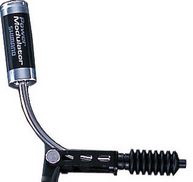
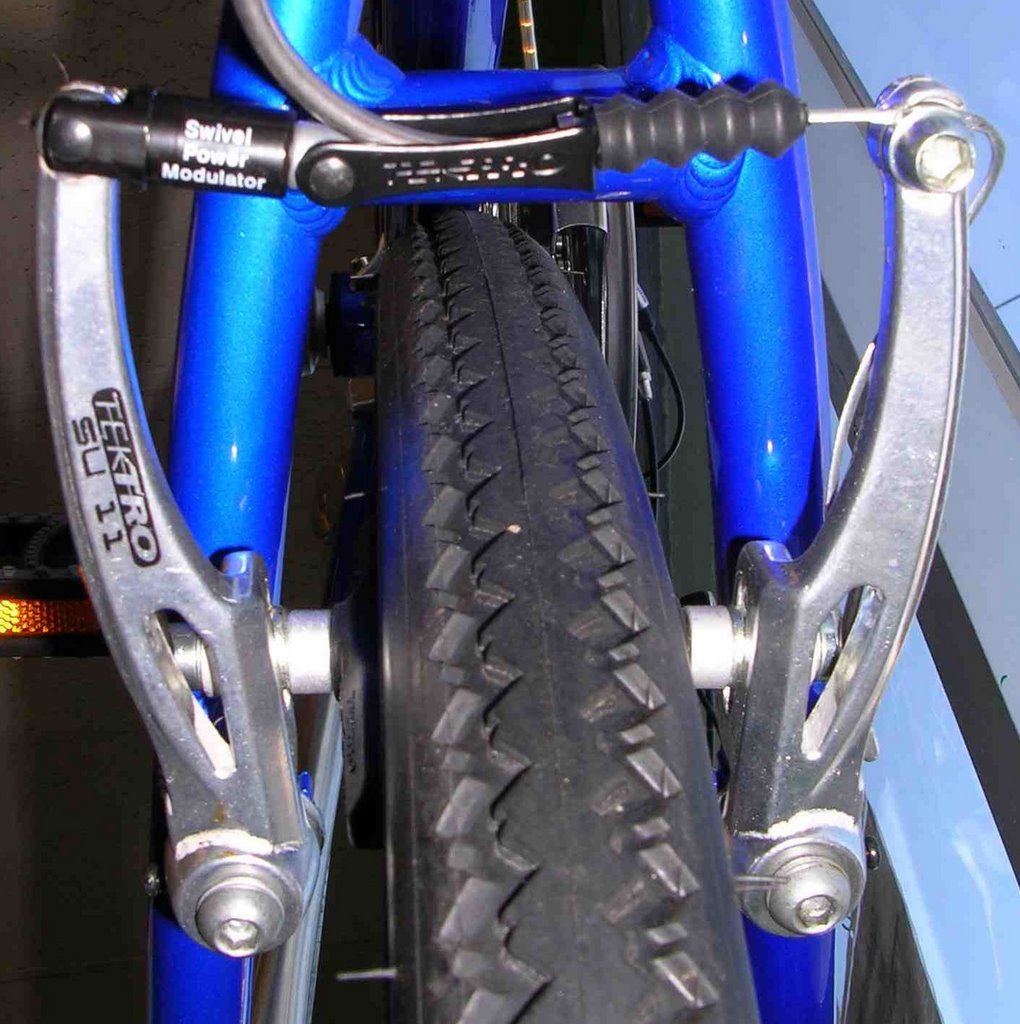
I dunno why they did it — it’s really beyond me. Maybe they were afraid people would — gasp! — replace the stupid force-limiter-noodle with a regular one. Anyway, the fine folks at Tektro moved the force-limiter from atop the noodle to between the brake arms in their SU-11 model (maybe others, I dunno). When a brake lever is actuated, the brake arms approach each other. The problem with the SU-11 is that the force limiter, not only occupies some space between the arms, but as it extends through it’s motion it closes the gap even more. Under certain circumstances, the force-limiter can allow the hanger (the part the noodle sits in) to bottom out on the far brake arm, which makes providing additional brake power impossible. It’s an amazing feeling — not something I had ever experienced before. It felt like a block of wood or something was between the brake lever and the handlebar. I was stunned that Tektro would make such a bad design. It was uncharacteristic of them in my experience.


On the SU-11s, there was only about 2.3cm between the end of the hanger and the far brake arm. Compare the picture above with this one of a more standard linear pull brake. Check out the gaps between the hanger and the far brake arm. OK, so the pictures kinda suck, but hopefully you get the idea...


Two Wrongs Don’t Make a Right
I originally saw this problem on a new bike, with new brake pads, and the situation could only get worse. As the pads wear, the brake arms have to move further in order for the pads to reach the rim, making it more likely the hanger will bottom out on the far brake arm. Tektro (I’m guessing) had “thicker” brake pads with extra material made to try and keep the SU-11 arms farther apart and help prevent the hanger from bottoming out on the far brake arm. Just one problem though: those brake pads are not standard, and when they wear out, the bike owner is probably just going to have them replaced with a more common linear pull brake pad. That means that the danger of the SU-11 brake design may only be revealed at that point on an unsuspecting cyclist. Talk about a weak fix!


They’re BA-ACK!

I thought I’d seen the last of this lousy design of brake at the end of 2005, but unfortunately, it’s back on some 2007 bikes. I’m so pissed about this that I decided to blog about it (duh!), and ask others to contact the Consumer Product Safety Commission to ask for an investigation (see below). Apparently, that is the first step consumers take to get a product recalled. Manufacturers may initiate a recall, but Tektro hasn’t done so (I contacted them in 2005 about this issue). Granted, they basically had no U.S. presence then, but apparently have a “warranty guy” in this country now. I hope they get their act together.


Shizzlestorm?

It’s with a little trepidation that I rant about this whole issue, I guess because I fear some retribution or judgment or even legal action. I decided though that my responsibility is to the cycling public, who might hurt themselves on bikes with this brake. Therefore, like the last time I saw these on bikes I carried, I am replacing them, regardless of whether I will be compensated by the manufacturer or bike company that spec’d them. I’m sorry if posting this blog entry makes either of them uncomfortable, but tough crap — this is people’s safety we’re talking about. It’s my reputation and livelihood too, and I’ve tried to “do the communication thing” with the appropriate companies. Now I’m trying for some more leverage, and you can help. Together, maybe we can get something to happen.


Won’t You Join Me for Some Tough Love?

Not that kind — wrong blog! I’m hoping folks will contact the Consumer Product Safety Commission (CPSC) and ask for an investigation into this brake design. Maybe Tektro will do the right thing and recall this brake, compensating those affected by it. A recall isn’t the worst thing in the world. Shit happens, and people make mistakes (though this is a pretty amateur one, I gotta say). The thing the matters is how they respond to them once they are made aware of a problem. IMO, Kryptonite did a great job with their U-lock recall a couple years ago (kudos to them).

Anyway, as far as I can tell, this link will take you to the right place to report the Tektro SU-11 linear pull brake:

https://www.cpsc.gov/incident.html


Let the bondage, uh, TOUGH LOVE begin!

Sunday, December 10, 2006

OK I Suck, But Bad Bike Racks Suck Worse

I’m getting some (polite) crap from folks who want more rants and less silence. Fair enough. I’m from, New York, ya know, so just be careful what you ask for….

OK, today’s rant is about bike parking racks: most of them suck, and are a disservice to cyclists. What’s ironic is that some of the worst designs are the ones that bike shops carry. I suspect that is because the same things that make a rack easy (cheap) to ship also makes their design lousy. Obviously, nothing related to security should be bolt-together. I tell colleagues in the bike industry that they wouldn't ever put their name on a lousy department store “bike”, so why sell the Huffy-equivalent in bike racks? I’m dismayed that people in the bike industry often don’t know what makes a good bike rack. It makes me suspect that they don’t use bikes for transportation. Yeah, bikes are fun, but they are legit transportation too, and they/their riders deserve to have good, secure parking.


Maybe It’s For Job Security?
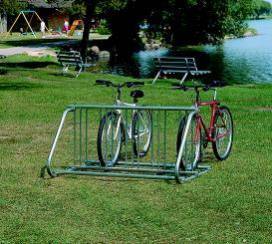
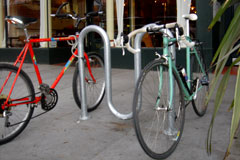
One of the most ubiquitous and crappy racks out there are the “wheel-bender” variants. Such racks hold bikes by their wheels, and should the bikes fall over (which they do because of poor design), the wheels get damaged. Also, they are usually very difficult to use high-security U-locks on them to protect both the wheels and frame. Maybe they help sell more replacement wheels? Personally, I’d rather sell replacements wheel because folks wore out their wheels from lots of use, not because they toasted their wheels in a crappy parking rack. If you see racks like that, be sure to put your bike parallel to it so that the whole bike frame is supported. Some folks might not understand and think you are a jerk, and that’s a shame, but your ride is important, so do it and never mind the haters.

Wheelbenders are so common, that they dominate results of a Google image search for “bicycle parking rack”.


Candy Coated Crap
Wow, how’s that phrase for rant-like? Well, unfortunately, lots of nice-looking racks actually are poorly designed. So-called “ribbon racks” are seen as attractive my designers or architects because of their aesthetic lines. Aesthetics are a secondary concern. Function is the main goal here. Ribbon racks are intended by manufacturers to be use in a perpendicular fashion, much like wheel-benders, and they do not support bikes properly either. If you need to use them, again, park parallel to them.

Think twice about gimmicky-looking racks. The “cutesification” of things usually results in a worse product, I think. No need to “suffer for fashion”. Decent, nice-looking racks do exist.

Better Mousetrap
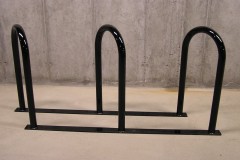
So what makes a good rack? Well, it should support the whole bike and not just a wheel. Also, the rack should be tall enough to support the bike near the top of the frame, so bikes don’t tumble over it. I really like the simple “A-racks” or inverted-U-racks. They are low-profile and can be used individually in pubic areas, or, where space allows, can be installed in a gang. A group of angled ones help keep the bikes low-profile which can be helpful in certain installations. When connected by plates at the bottom of the hoops, the rack can be self-standing, though premanently fastening a rack to the ground is important for security.

Cha-Ching’s The Thing
One problem with racks like these is that they are expensive to ship. The alternative is to have them welded locally, which helps your local economy. Maybe ye local welding shop will help defray costs for making racks are donated to the community. They gotta eat too, though, so don’t be bummed if they can’t swing a deal.


So Close and Yet So Far – Or Not Far Enough?
Good design is only part of the issue, though. Good placement is another major factor. Time and again I see good racks installed poorly, such a Cora rack right up against a wall, cutting its capacity in half. Cora is one of those companies that “gets it” though and provides installation guidance that points out how placement affects access. That was cool of them.


Bike Parking Standards
More communities are requiring bike parking as part of their development codes. That’s great as long as they specify:

- good rack designs to be used/prohibit bad ones
- proper location (e.g. near building entry/exit and under adequate rain shelter)
- proper installation is made explicit (to maintain capacity)


But It’s Just a Bunch of Words
Standards are only useful though if they understood and enforced. Your community’s officials and planners might need education on how to maximize the rack's usability. Often, they don't bike and have no idea how their work affects end-usability. If they don’t get it or don’t buy in, don’t expect to get good results on the ground. Often bike racks are one of the last details to get installed in a development, and the installers might have no idea about cycling, the rest of the development project or the code requirements (if there even are any). I’m not saying bike racks are on-par with the seismic safety of a building in terms of importance in code, but it’s not rocket science either for goodness sakes.

The Association of Pedestrian and Bicycle Professionals has a good resource on bike parking that can be helpful for educating people. You might even want to send this link to your local bike shop to help ensure they know what makes good parking (you’d be surprised): http://www.bicyclinginfo.org/pdf/bikepark.pdf.

OK, that's all (for now). I got a doozy of a rant in store for next time.... Thanks to the folks who bugged me to stop being a slacker.

Tuesday, September 26, 2006

Anti-Helmet Law Rant

Sometimes cyclists complain about other cyclists who don’t wear helmets. While I wear a helmet and would like every cyclist to do so as well, I am not in favor of forcing him or her to do so. Here is an editorial/rant I wrote about it:

Helmets don't prevent "accidents" (that term isn’t even right — they are collisions, not accidents). Rider skill, rider and driver adherence to the law, and proper facility design are what reduce the rate of collisions. Helmets might affect the frequency and severity of cyclist head INJURY, but only if properly fit, adjusted and used. Alas, helmets are more complicated to use than seat belts (and even those are not perfect solutions for all, thus we have child seats and boosters). This is evidenced by the scores of people who wear helmets that are ill-fitting, improperly adjusted, or both. I include members of bike clubs in that observation, so being an enthusiast still is no guarantee of proper helmet use (and therefore proper protection). Moreover, wearing a piece of polystyrene on one's head is no guarantee that traffic laws will be followed, and does not signal to drivers anything significant about the competency of the rider. Many helmet-wearing cyclists routinely break traffic laws in such a way that might endanger themselves and others.

If you are anything like most other cyclists I know, you didn't wear a helmet when you first learned how to ride a bike. You weren't an idiot then, and neither are today's cyclists without helmets. I can think of a few reasons why a cyclist might not wear a helmet and none of them indicate much of anything about their worth as people or even if they are “serious” cyclists, or worthy of respect by drivers. I doubt anyone would call the tens of thousands of daily bike commuters in countries like the Netherlands, where helmet use is low, as idiots.

Coming down on fellow cyclists who don't wear helmets is a waste of our energy at least, and perhaps even counter-productive to cycling as a whole. Cyclists are a minority in terms of transportation mode split. Due to the built environment and disparity in power between even an elite racer and the humblest of cars, combined with our culture's lack of patience and compassion (read “patriarchal cruelty and propensity for road rage”), cyclists may even be considered an oppressed minority of sorts. To then attack other cyclists for not wearing helmets seems, therefore, like internalized oppression. Would that we could get respect from all other road users simply by donning helmets! I'm sorry to say that won't do it any more than sending all women to college will stop sexism (because both oppressions are deeply rooted and institutionalized, involving more than just the oppressed party — the oppressors must change too). Additionally, no cyclist should ever feel or be made to feel responsible for the actions of other cyclists; there is no such corollary pressure on drivers. Buying into this double standard only perpetuates cyclist oppression.

Instead, we should all work to make sure that society is properly providing what cycling as a transportation mode and form of recreation really needs. Pete Lagerwey, Seattle's Bike Coordinator, is fond of saying (and I of repeating), “Good facility design invites right behavior.” True, but no facility will always prevent the ignorant or even willful disregard of traffic laws. That is where safety education and, eventually, enforcement come in (though 100% compliance will always remain an asymptotic goal). As a bike safety advocate I promote helmet use yet fight mandatory helmet laws despite the fact that as a bicycle retailer, I'd make money from such a law. Why? Because I dislike the oversimplification used in rationalizing such behavior control — helmets don't prevent collisions (I am far from a libertarian, though, guns DO kill people). I'd rather see bicycle safety education institutionalized in schools than profit from legislation that did nothing to educate cyclists (and the eventual drivers most of them also become) about how to safely use and share the road. Most cyclists don't even know how to properly use their front brake, let alone how to properly negotiate a busy, multi-lane street while preparing to turn left. I think that properly educated, mature cyclists will usually chose to wear helmets. As a bonus, they themselves will know how to fit and adjust their helmets. This provides a bigger benefit than not providing education yet forcing cyclists to wear helmets under the threat of a fine.

I'm far more comfortable with seeing good safe and legal cycling form coming from a rider without a helmet, than the reverse. I'd rather see an educated, helmeted rider, but I'm not going to berate a cyclist for not being one, and neither should you.

Tuesday, August 08, 2006

I Coulda Been a Contenda

Several years ago, I needed to improvise a tool to work on some cartridge bearing hubs -- if you press on the inner race of the cartridge you will ruin it. I came up with a good idea and sent it in as a submission to a mechanic tip contest held by The Third Hand/Loose Screws (a mail-order bike part and tool biz). I never heard squat back -- I'm pretty sure they took my idea and made TENS of dollars with it, but I still like them anyway. Moreover, I still like my idea. Here it is:


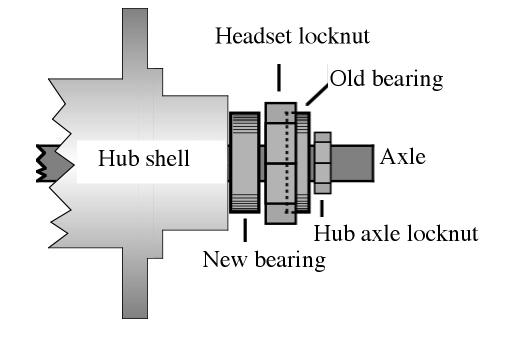
While overhauling a cartridge bearing hubset, I realized that I didn’t have a tool for installing the new cartridges. Wanting to press the new cartridges in (rather than hammer them in), I needed a tool that would to guide along the hub’s axle while only contacting the outer race of the new cartridge (a la Specialized’s cartridge installation tool that looks like a cartridge with a protruding outer race). Lo and behold, the old cartridge slipped perfectly into the backside of a 1” headset locknut, making a unit that would satisfy both criteria. It worked like a dream as the axle locknuts drove the new bearings into the hub shell.


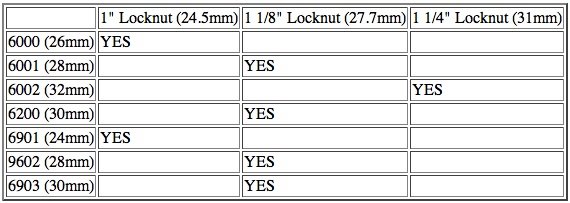
I then wondered what cartridges the other size locknuts might accommodate and made a table with the locknut inner diameters, various common cartridge bearings and their outer diameters, whether a certain locknut will accommodate the bearing. A little machining (of the locknut’s inner diameter) is usually required for a fit, but using an aluminum locknut makes that an easy task. This tool is cheap and will last a long time, so press on and roll smoothly!

OlyBikes Blog Intro

This blog was created by the folks at OlyBikes, a small, independent bike shop in Olympia, WA. We like talking about bikes as much as riding and working on them, and have a lot to share, so we created a blog. Hope you enjoy it. BTW, we would like to hear from other bike freaks out there and if you have some cool thoughts or ideas you'd like to share, send them to us and we'll post them.