Tuesday, August 17, 2010

Saturday, August 14, 2010
Capitol Forest Ride #1: Fall Creek 8-50-6
Capitol Forest has lots of great riding. For cross county riding, it arguably does not get any better than the loop of 8-50-6 out of Fall Creek Trailhead. Total ride length is about 10 miles, great for a beginner or a quick spin for more experienced riders. It offers a pretty consistent climb up 8, that is not very technically challenging -- very doable on a rigid bike as an out-and-back to Trail 50 (and then back to the trailhead). The junction of 8 and 50 is odd in that you "go straight" to get on Trail 50, whereas 8 continues with a sharp left towards Wedekind. The map doesn't provide such on-the-ground resolution, so it bears mentioning. Trail 50 itself is a welcome change with a much easier grade and faster speeds. Turning right/downhill at the intersection of Trail 6, you head back to Fall Creek. Trail 6 is almost pure descending (except for right after the bridge over the West fork of Fall Creek), and has some technical sections and root drops, reasonable jumps and berms aplenty. Much of that fun stuff is due to the fine work of Friends of Capitol Forest an organization that gives a lot of time and energy to make sure we have great riding locally. They deserve your support. Consider volunteering or making a donation to them. There is an optional extension to continue onto Wedekind (see yellow highlighting below), but be aware that it will double the length of the ride. You could also do Trail 8 to Wedekind as an out-and-back and then continue onto 50 and 6. 
This ride starts and ends at the Fall Creek Trailhead, accessible from Delphi Road on the Westside of Olympia.
Please be aware that these are shared trails and you may encounter other cyclists, hikers and equestrians. Do your part to share the trails. At a minimum, let folks know if there are other riders in your group behind you. Additionally, it is advisable to talk to equestrians and ask them how they'd prefer to proceed -- to have you pass them or have them pass you, whether they'd like you to dismount, etc. It is often a good idea to talk to the horses, as they are familiar with the sound of human voices and which helps them realize you are not a dangerous predator. Be an ambassador for trail riding. Have fun.

This ride starts and ends at the Fall Creek Trailhead, accessible from Delphi Road on the Westside of Olympia.

Please be aware that these are shared trails and you may encounter other cyclists, hikers and equestrians. Do your part to share the trails. At a minimum, let folks know if there are other riders in your group behind you. Additionally, it is advisable to talk to equestrians and ask them how they'd prefer to proceed -- to have you pass them or have them pass you, whether they'd like you to dismount, etc. It is often a good idea to talk to the horses, as they are familiar with the sound of human voices and which helps them realize you are not a dangerous predator. Be an ambassador for trail riding. Have fun.
Monday, May 31, 2010
Jandd Waterproof Saddle Cover
We live in the Pacific Northwest, a very wet area, as any frustrated Olympian awaiting spring this year can attest. Despite our wet weather, commuting and doing errands by bike is pretty popular here. Good bike parking under cover from our frequent rain is not always available, yet we have some compelling reasons to want our saddles to remain dry: 1. We enjoy tensioned leather saddles, that should be kept dry for proper longevity. 2. A wet butt is usually attached to a sad rider -- even if your saddle can get wet, it is not very fun. We have carried and used several waterproof saddle covers over the years, and liked many of them. Some are no longer available, such as Truant's cover. Jandd offers a pretty darn good one that we carry now and recommend for anyone, regardless of whether their saddle can survive getting wet or not. The cover has a very tidy appearance, with a webbing strap the holds the cover in a tight roll via velcro. Unrolled, one can see a decent waterproof coating, though it is not seam-taped. In use, though, this has not proven to be an issue because there are no seams atop the cover, unlike many other offerings out there, so there really is no way for rain to penetrate. Way to eliminate a major failure point, Jandd. So, how's it fit? It fits PERFECTLY on a Brooks Pro/Conquest/B-17, and snugs up like a dream with the included shock cord. Very nice, indeed:

This product is intended to be for use when the bike is parked -- it is not for riding on. That might sound funny, but many folks are used to covers that are intended as "re-upholstery" for a worn saddle, like the old Avocet saddle covers. If you ride on the Jandd saddle cover, you will likely abrade the waterproof coating, ruining the it. Instead, use the cover only when parked, and stow it when riding the your bike. Think about it. When you are riding the bike, you are protecting it from rain. We do note that there is no "leash" to prevent the cover from being lost accidentally. We have a workaround, though. Loop the shock cord around a saddle rail and put the whole cover through that loop. You can still deploy the cover and also roll it up and store it under your saddle above the rails. This way, if it the cover ever came off your saddle, whether deployed or stowed, it would still be attached to your bike. Here's to dry saddles, dry butts, and well-made products. Come on down, and get set up with a Jandd saddle cover. Now, about the lousy weather we've been having....


Posted via email from OlyBikes
National Trails Day is Saturday, June 5th!
There is no better way to show your love and appreciation of our trails, be they paved, gravel or dirt, then by helping to work on them. The Woodland Trail Greenway Association has a number of small work parties at 9AM this Saturday and a celebration at noon as well: Olympia: Put mulch mats on our newly-planted trees at the Fones Road Crossing of the Woodland Trail. Contact Jack Horton (360)789-0944. Lacey: Invasive species removal at Woodland Creek Community Park at the east end of the Woodland Trail. Contact Lori Flemm (360)701-6814. Thurston County: Invasive species removal at the Chambers Lake Trailhead of the Chehalis Western Trail. Contact Kerry Hibdon at (360)867-2181. Celebration at NOON: Wrap-up at the "T" intersection between the Woodland Trails and the Chehalis Western Trail for light snacks and a celebration. Enjoy the trails: ride your bike or longboard; skate or walk. Just get to the intersection of the Woodland Trails and the Chehalis Western Trail by Noon! If you are not familiar with this location, call Jack Horton (360)789-0944 for directions. Alternately, if you prefer off-road trail work, volunteer with Friends of Capitol Forest to make new sanctioned trails, and repair storm-damaged ones; FOCF will soon be building a bridge out of modular parts volunteers carry in -- cool! Drop them an email if you'd like to help out. Thanks to all the volunteers out there. Happy National Trails Day!
Posted via email from OlyBikes
Sunday, May 30, 2010
Chehalis-Western Trail (CWT) Bridge Opening
Despite the fact that the ribbon cutting on the CWT Martin Way bridge was a couple months ago, I still wanted to acknowledge it, and also to report on the prospects for the final bridge over Pacific Avenue.
Also, as mentioned earlier in this blog, Congressman Brian Baird was at the ribbon cutting ceremony, where he recalled the "citizen lobbying effort" about this phase of the project:
BTW, he's kidding about almost getting killed, though, right Congressman? Uh, sir?
(Olympia Power & Light also reported on the story, but I am sorry to say I cannot find a weblink for it.)
Anyway, I want to thank everyone involved in the project, as well as all those who came out to the even, undeterred by the iffy weather. Ironically, May's weather has been worse compared!
Very Good News: Pending closeout of the project, word from Thurston Regional Planning Council staff is that there is enough money left to fund property acquisition, design and possibly even full construction of the last portion of the "Gap Project" over Pacific Avenue, near the "Kite Girl" statue in Lacey. I wonder if she'll find another place to reside....
1 --Posted via email from OlyBikes
Thursday, March 18, 2010
Two Down, One to Go! Martin Way Non-motorized Bridge Opening
Yes, it is a time of celebration for bikers and walker in Thurston County because of the imminent completion of a project to help link up the north-south backbone trail in our region. The Chehalis-Western Trail is bisected by a "gap" comprised of three major crossings: I-5, Martin Way and Pacific Avenue. First we tackled the I-5 portion, thanks largely to the hard work of then State Legislator, now County Commissioner Sandra Romero.
This celebration is for the completion of the second phase of the project, a bridge over Martin Way. Congressman Brian Baird has been instrumental in funding this project, as well as the third and final phase (a bridge over Pacific Avenue). He'll be on hand for the ribbon cutting ceremony, and we hope you will be too. Details follow.

--
- Larry Leveen
OlyBikes Locally-Owned Bike Shop "Bikes, Parts, Repairs and GREAT Customer Service"
124 State Avenue NE
Olympia, WA 98501
Phone: 360-753-7525
http://www.olybikes.com
(FREE bike safety & advocacy materials)
also on Twitter & Facebook
Posted via email from OlyBikes
Cell Phone Bill on Governor's Desk!

The cell phone bill is expected to be signed into law very soon, and we are requesting you help us get the Governor to sign it.
Please take a moment to call Governor Gregoire's office in support of the bill. It simply takes an "I support SB 6345 and hope the Governor signs it into law soon!"
The phone number to Gov. Gregoire's office is 360-902-4111.
Thanks for helping to keep our roads safe.
Posted via email from OlyBikes
Bridging the Gap Phase 2 Ribbon Cutting!

Thursday, March 11, 2010
National Bike Summit Crankin' it Up for Cycling
The past couple days I've been in Washington D.C. along with scores of other advocates for the 10th Annual National Bike Summit. Local, regional, state and national advocacy groups of all types - on and off road cycling, transit-oriented health-oriented, and, I'm proud to say bike _industry_ organizations have gathered for an intensive training and issues briefings, followed by visits to members of Congress. We're asking for a variety of things, including, co-sponsorship of various bills to help support Safe Routes to Schools, Active Community Transportation, Complete Streets (i.e. not just moving cars, but moving people by including all modes in projects with federal funding). I've been spending most of my time with staff from both Bicycle Alliance of Washington and Cascade Bicycle Club, visiting our legislators. It's been nice to do some catching up and comparing of notes with these folks, as well as say hi to the more progressive folks in the industry who get it that we have to "grow the pie" by getting involved. Washington's congressional delegation tends to be supportive (especially west of the Cascades), but with so many things vying for staff and legislator attention, it is important to deliver these messages in person. Schedules are of course busy, and sometimes a staffer must fill in, but is not a disappointment, as a staffer is likely your best advocate, having "the bosses ear" daily, and preparing their legislative agendas and informational packets. We were able to meet with Brian Baird's Legislative Director and Patty Murray's Legislative Aide, and Senator Cantwell herself. We then had a stroke of luck and squeezed in a meeting with Senator Murray herself, who was rushing from one meeting to the next, to present her with an award from the League of American Bicyclists for her work for cycling in our state. Stay tuned for pix (my kingdom for an iPhone!). I'm taking a break in a lounge to catch my breath (and write this!). Following that, we'll head over to meet with Representatives Jim McDermott and Adam Smith, who are from districts north of mine (The Bikin' 3rd!), but who I think have plenty of reason to support our causes. More as it comes!
Posted via email from OlyBikes
Monday, March 08, 2010
Urgent Action Needed on Cell Phone Bill

Last week the House passed an amended version of the cell phone bill (Senate Bill 6345). While they supported the ban on texting while driving, the House weakened the Senate bill by reducing handheld cell phone use back to its current status as a secondary offense. Boo!
The Senate has rejected the amended version and pushed the bill back to the House. Please take action!
Write or call your legislators in the next 24 hours and ask them to pass the ORIGINAL version of SB 6345.
The pre-written message using the link below has been changed to reflect this call-to-action. Please send to your House member right away, and pass this link to as many people as you can.
Session officially ends on Thursday, so time is of essence.
As usual, spread the good word to help keep all of us safe. Thanks.
Posted via email from OlyBikes
Wednesday, March 03, 2010
The Kind of Cell Phone Bill You WANT!

Another important announcement from our friends at Bicycle Alliance of Washington:
The Bicycle Alliance is a member of the Driven to Distraction Task Force. We are thrilled that Substitute Senate Bill 6345 is close to becoming law! Below is a message from the task force:
The Washington state legislative session ends in 8 days, and we need your help in our final push for Senate Bill 6345. With your help, handheld cell phone use and texting while driving will become primary offenses in 2010! PEMCO just released a poll revealing the number of WA drivers using handheld devices illegally has more than doubled over the past 20 months, and texting while driving has skyrocketed even higher.
What we urgently need your help today to help curb this alarming trend:
1. Take a few minutes to e-mail your representative using the online link below, even if you've done it before. To find out who your representative is and how to contact them, click here: http://apps.leg.wa.gov/districtfinder/
2. Forward the following e-mail/action link to as MANY people as you can that live in Washington and ask them to contact their representative in support: http://www.votervoice.net/groups/driven
SSB 6345 will likely go to the full House floor today for a vote, and every e-mail and phone call to legislators in support of this bill will help. If you or your colleagues hear back from a House representative, please forward any responses to info@nodistractions.org.
And hey, this isn't just about cyclist safety -- this is EVERYONE's safety on the line here, so contact your legislator now!
Thanks.
Posted via email from OlyBikes
Tuesday, March 02, 2010
Bike & Pedestrian Safety Bill in WA Needs Your Help
I've described OlyBikes before as "the day job which satisfies my advocacy habit". More accurately, though, it is really "one-on-one advocacy" (helping folks use and enjoy bikes for transportation and recreation) that supports my "legislative advocacy" habit. Most days, it is the former and not the latter, but today, I need to ask you to help with a legislative need. The following is from our friends at the Bicycle Alliance of Washington:
Many of you have already heard from me regarding HB 3001, our bike/ped safety bill. The bill has been doing well and now is our chance to get it significantly closer to being law. So, I am now asking you to make what I hope is the last phone call or email.
Contact your Senator right away and ask them to <b>vote "Yes" on HB 3001 as amended by the Senate</b>. To find out who your Senator is and get their contact information, click here: http://apps.leg.wa.gov/districtfinder/ We prefer that you call them.
HB 3001 would require the already approved bicycle/pedestrian awareness curriculum be taught in traffic schools which are for drivers that have received infractions and may qualify to be granted a deferral of the infraction by attending the school. Many licensed drivers do not have knowledge about such safe driving practices. The materials for these classes will be paid for by the Bicycle Alliance so there is no cost to the state.
Expanding the curriculum requirement to traffic schools from drivers education schools where it is already required would increase this important knowledge about safe driving practices.
Thank you and please contact me if you have questions or need additional information.
Dave Janis, Policy Director
Bicycle Alliance of Washington
206.224.9252 Ext. 302
I'll try to make it easy on you South Sounders. Here are some local districts and the contact names and numbers:
22nd District Sen. Karen Fraser (360) 786-7642
20th District Sen. Dan Swecker (360) 786-7638
35th District Se. Tim Sheldon (360) 786-7668
<b>Please call now -- I just did and it took all of 30 seconds. Thanks and spread the word!</b>
--
Posted via email from OlyBikes
Friday, February 26, 2010
Bridging the Gap Phase II Nears Completion!
If good things come to those who wait, then this is going to be really good, because we've surely been waiting a long time!
In this case, we've been waiting for Phase II of the Bridging the Gap Project, to join the northern and southern sections of the Chehalis-Western Rail Trail (CWT). The CWT is the major north-south trail in Thurston County. It's been pieced together and developed over a number of years, and, when complete, it will connect the northern and southern portions of the trail so that anyone in an urbanized area in Thurston County can bike to Puget Sound on a trail system.

The image, courtesy of Thurston Regional Planning Council www.trpc.org, shows an artist conception of the finished bridge over Martin Way (from the north side, looking south). Word has it that we are just a couple weeks away from being able to use this bridge and a couple more after that from having an official ribbon cutting ceremony. Stay tuned for that, and spread the word.
Following completion of this phase, we'll have just one more phase left -- a bridge over Pacific Avenue. My sources tell me that they are optimistic that we'll have adequate funds to accomplish that once the current project is closed out. They just have to go through the seat cushions for all the loose change.
For more project info on Bridging the Gap, see: http://tinyurl.com/2aqjpm
And hey, the real truth is, good things don't come to those who wait. They only come to those who get active and involved. The best way to make a difference locally is to either:
- Apply to be on the City of Olympia Bicycle and Pedestrian Advisory Committee: http://tinyurl.com/ykex8ao
- Contact the Capital Bicycling Club's Advocacy Director and find out how to get involved with existing efforts or to initiate change on your own local bike issue.
Posted via email from OlyBikes
Monday, December 14, 2009
Solo Trail Spin in Capitol Forest

I'm amazed at how early some folks get up to go riding. I can't seem to get myself together early enough to make the local trail rides -- those people must have straight jobs, or something. I found myself with some extra time midday on Saturday, 12/12/09, which was still during that cold snap, if you recall. I was able to borrow the car, so I headed out to Mima Falls Trailhead for a solo trail ride. Extra clothing -- check! Extra food -- check! Headlamp -- check! Note in a bag on the windshield with my name, an emergency contact name and number (I don't have a cell) and my intended route (plus a couple alternates) "just in case" -- CHECK! Ready to ride?! Eh, not so fast Einstein....
The gate at the trailhead was closed, but I wasn't about to let that stop me since I had driven all the way there to ride. There was room by the side of the road stub to park. And park I did -- rather poorly as it turns out. I whacked my front wheel pretty far out of true on the far side of the swale next to the road. Since I figured that the ride would be significantly enhanced by the ability of my front wheel to actually spin without hitting my full 29er Cascadia Frankenfenders, I quickly removed the wheel, assessed the patient's symptoms and judiciously applied a technique that we bike doctors refer to as "velox vis obviam terra" or, in lay person's language, "quick force against earth". I'm pretty good at it, too, and had the wheel it pretty excellent shape in just three whack.... uh, I mean three applications of this therapy. Reinstalled back on the bike, the wheel spun freely without contacting the fender at all. Good thing as it was probably coming up on 2PM, and there wasn't a heck of a lot of daylight to work with (the sun sets around 4:22PM these dark days).
Gear Nerd Alert
Despite the chilly air (~34 F), I trusted the mantra "If you're warm enough when you left, you're overdressed". It doesn't come naturally, but I was glad I forced myself not to over-insulate from the get go. Setting out, I had just the right amount of clothing on (the rest was in my pack) as I set out Mima Porter #8: thick wool socks, waterproof Shimano MTB shoes, lyrca shorts and thick lycra tights atop them, wool long sleeve shirt with wool short sleeve atop it. Though it seemed as though I might be able to ride in my long fingered Pearl Izumi gloves pretty comfortably, my hands were cold pretty immediately (I have lousy circulation in my hands and feet). I switched to some Louis Garneau gauntlets I also had with me.

Those really did the trick, just as they did on my bike tour in Death Valley last December. I credit this to the fact that the hand portion of the glove is fairly loose-fitting and because gauntlets go _over_ sleeves and end higher up the arm than normal gloves with a cuff you have to put under a sleeve (which gets bulky and cuts off circulation at the wrist). With gauntlets, you can keep wind out without cinching anything down, plus, whatever pressure it exerts is further up the arm, where I suspect the blood vessels that serve the hands/fingers are "less superficial" so they aren't as vulnerable to a tourniquet effect. If you have trouble keeping your hands warm, try loose and _long_ gauntlets atop your sleeves. I think you'll find that they improve your circulation markedly. It's a different approach from what the outdoorsy establishment pushes, but who cares if their approach yields frozen and number fingers? I'd like to still be able to squeeze my brake levers at crucial moments than win a fashion contest.
That all said, I still had some problems with my hands getting cold/numb, though, which I attribute to the Ergon grips I've been trying. I've ridden four times with them, and my conclusion is that I don't like them for trail riding, at least with the Origin8 Space Bar I run on my XC hardtail. The backwards flare of the Ergons seems to wind up pressing on my ulnar nerve which causes my hands to go numb and also loose circulation. I fault the grips and not my gloves, because as I said, I used those gloves on a tour in Death Valley which entailed all-day riding (on drop bars, which I dig) without the same problem (as far as I recall).

This Was Supposed to Be a Ride Report, Right?
Anyway, it was great to be out, to be alone and enjoy the "corn flakey," crunchy, frozen surface. Riding solo aside, I tend to err on the side of safety, so "just in case" I made a few arrows out of sticks to show any potential searchers which trail option I took whenever there was an trail intersection.
As I cruised along MP8, I enjoyed the views and sounds of the partially-iced-over Mima Creek. A while later I saw a grouse that I had startled. I stopped to watch it and listen to that three-stooges kind of sound it made as it took cover in short hop flights. While I did that, I also noticed a small woodpecker and wondered how the thing could possibly drill into the frozen bark of trees to get any food. Feeling luck my snacks were just a zipper away, I headed on.

Aside from a few small descents by Mima Creek, most of my ride along MP8 was pretty level or climbing, and when I stopped for a snack or to stretch (my back hurts unless I do this a few times during a ride) I consulted the map to check out the topo lines. It seemed like once I was on GL6, it would be mostly flats and descents. I decided that at that point that I'd break out the rain jacket and balaclava to help keep me warm. Good choice. I wouldn't have been bummed to have brought my ski goggles, but I left home without them. In the cold air, descents entailed more blinking than John McCain in a presidential debate.
A short way into GL6, there was a clearcut with a view of Mt. Rainier lit up by the sun setting behind me. It was beautiful, and there was a perfect stump-seat next to the trail, so I stopped and enjoyed the solace of the experience while I munched on a sandwich and some satsumas. The temperature was starting to dip, though, so I didn't want to dally very long.
Overall, the trails were super-buff (even with lots of twigs from the recent windstorm) to the point that they were almost completely non-technical, but that's OK as I was up for a more of a "trail ride" and less of a skills-fest where coming up short would could have bigger consequences than when riding with buddies. Two exceptions to the trail conditions were:
- (Heading east) on GL6 just after the switchbacks north of D-4600 (right about where the "#6" is on the map in section 29). There was a large dead tree that fell right into/in-line with the trail _immediately_ after the very last switchback. Thankfully, not only did I not hit it, but it was so rotted that when it fell -- possibly in the recent windstorm -- that it broke up into person-sized logs. I figured I'd give moving them a shot, and to my surprise, it went pretty well. The last one was a hell of a struggle, but after wrestling with it, I was plenty warm again!
- (Still heading east, in map section 29) on GL6, another large tree fall, this time _across_ the trail, but there wasn't squat I could do about that one. That's a job for a chainsaw, and while I tend to over pack, I didn't bring one with me.
I was concerned about GL6 back towards M.F. trailhead because of a note on www.capitolforest.com that says the Washington Department of Natural Resources has closed "a short section of non-motorized trail between Margaret McKenny campground and the E-9000 road". The website didn't specifically say the closed trail was GL6, but I figured it probably was, so I took #10 back to MP8 (thanks consider this an appeal for that closure notice to be changed/clarified). The last time I was on #10 was several years ago during the late spring when it was so muddy we had to push our bikes 3/4 of the way up the trail -- I think we were headed the other way at the time). Our bikes were so packed up with mud that I recall wryly saying to my riding buddy that day that I thought the trail name was a reference to how many pounds of mud per wheel your bike accumulates on it. I was excited to try it out considering the ground was still frozen. Still, it was easy to see what a poorly drained trail it is from the scoured out sections comprised of small round rocks left after all the fine soil has been washed away. At one point, there was a 20 yard long section of mud crusted over with ice. I didn't want to wipe out and fall flat onto and then through the ice into the mud. The ice turned out to be thin, though, and as my tires broke through the ice crust, my pedals hit the ice on either side of the wheel track. I tried to use a ratchet-like pedal stroke so my forward crank wouldn't go past 4 o'clock, but I couldn't really make it happen, so I just ratchet-hobbled through that section. Humbling after clearing the rest of the ride so well, but I didn't bite it and land IN the mud, so I was cool with that.
As mentioned earlier, the sun was setting, and visibility (at least in the areas that still had trees!) was fading as I descended the final few switchbacks to connect with MP8 again, my stick-signal arrow from the beginning of the ride faithfully pointing west, though I was now heading east back to the trailhead. I picked up the pace as best I could to try and avoid having to stop and fish out my PrincetonTec EOS headlamp. It is OK for use around a campsite, around the house, or as a backup light around town, but it is far from ideal for trail riding in low-light conditions. Still, I grabbed it because it's a hell of a lot better than nothing, plus it's lightweight and packable. Thankfully, I reached the E-9000 crossing and then the junction of GL6 and was pretty home free well before it was too dim to see. In fact I could still make out the horrible wasteland of the timber sale adjacent to the trailhead. A bittersweet end to a fun ride, but you take the bad with the good in Capitol Forest. I still feel pretty lucky to have such a great trail system right in my back yard.
Thursday, December 03, 2009
RADBOT Will Save Your Rad BUTT
Portland Design Works is a relative newcomer to the world of bike accessories, though the staff there collectively have lots of experience in the bike world, much of it at Planet Bike. They've struck out on their own, though, and, to date... I haven't been blown away with their stuff. :-/
Sure, they offer all the requisite Portland bike scene things like trendy handlebar grips and a combo-axle-nut-wrench-tire-lever (and since fixie hipsters only drink PBR from a can, a bottle opener was omitted). The thing is, the bike world is awash in such products. In short, while I wished them well, PDW wasn't really doing anything that really captured my interest. Until now, that is....

That there is the RADBOT 1000. PDW's awesome new combination ONE WATT taillight with reflector. For the past couple years, Planet Bike's Superflash taillight has been the darling of the bike world. It's half-watt LED was a Great Leap Forward in brightness for the cycling masses, helping them be more visible to other road users. It was and is a good taillight, but time and technology march on.
Now, at almost the same price, PDW offers a light that is:
- Twice as bright - seriously, if drivers can't see this light, they should have their licenses revoked.
- Includes a rack-mount WITH the light - any bike with a cargo rack should run the taillight at the back of the rack.
- Includes a legit reflector - we are huge fans of running both and here's why.
Alternately, can get PDW's RADBOT 500, which is the same shape as the 1000 but with a half-watt LED. We're ALL ABOUT throwing a few extra dollars to get super-bright lights, though, so we stock the 1000s only.
My only gripes about the light are very minor:
- Including a fender mount would have been totally amazing (hint, hint, PDW folks).
- It would have been cool to see a rack adaptor that included a tab _to mount it to the rack_. Either your rack must supply such a tab (some do, some don't) or you need to fashion your own. If you go all DIY and make your own "adaptor adaptor", please make it mount to the rack with _two bolts_ so it doesn't swivel around. Bike mechanics/nerds will know what I mean when I say that Jandd got their design right and Blackburn got it wrong. That's why we carry the Jandd mount in stock for $4 which is way worth it, because it is light-mounting perfection in stainless steel form (again, hint, hint).
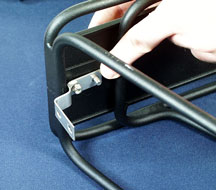
I am really excited that PDW has made such a radical departure from their product offerings with this light. I can't wait to see how other companies respond. For now, though, the RADBOT 1000 is king. In fact, we hereby declare the RADBOT 1000 is the best bike accessory for under $40, making it an ideal holiday gift (hint, hint ;-).
Posted via email from OlyBikes
Tuesday, December 01, 2009
Use Steady Beam -- Not Blinking -- Headlights
Use headlights in steady mode, not blinking. We have two reasons for this advice. First, we believe that it is much easier for other road/path users (not just motorists) to judge their distance from, and relative closing speed on a steady light source. This is crucial as the relative speed is the sum of the cyclist's and motorist's speeds, which reduces reaction time for the motorist. Also, flashing forward lights are generally reserved for emergency vehicles only, and we would hate to hear that a cyclist was found to be at fault when hit by a careless motorist simply because the cyclist's headlight was flashing, which is not the norm for any non-emergency vehicle.
That said, blinking rear lights are OK. The closing speed of a motorist overtaking a cyclist is reduced by the speed of that cyclist (we always assume the cyclist is travelling with the flow of traffic, as required by law). This gives the motorist more time to perceive the cyclist and avoid them. Also, many states, including Washington, specifically allow rear lights to blink/flash (there is no such allowance for headlights as far as we know).
Steady beam taillights are more than a fine idea for cyclists, for the same reasons of driver perception mentioned above for headlights.
Note, we are not lawyers but think that WA State requirement for rear lights, whether blinking or steady, is that they must be used in additionto a reflector, and not just in place of one. We are not aware of any cyclist being cited for using only a rear light, though. Read the laws here.
Posted via email from OlyBikes
Monday, November 09, 2009
Bicycle Headlights
Bicycle headlights can be divided into two groups:
- Higher-end lights bright enough for a cyclist to see what they are rolling over.
- Entry-level lights that cannot light up the road.
Higher-end systems start at $85, and entry-level lights are priced below that. OlyBikes sells both categories of lights, though we feature higher-end systems on our website.
Entry-Level Lights
We often refer to these as "defensive lights." They help make cyclists more visible to other road users, but simply are not bright enough to light up the road (so do not expect them to). They are fairly affordable, portable, lightweight, and make great backup lights for brighter systems, or even loaner-lights for a friend who has stayed past dusk.
Few of these lights are rechargeable, but you can always opt to use rechargeable batteries in them. Indeed, doing so will in short order pay for both the batteries and the charger -- especially if the light has incandescent halogen bulbs!
Last, but not least, defensive lights meet the nearly nationwide requirement that during evening hours, bikes be equipped with a white, steady beam (not flashing!), visible for 500 feet. Fines of $105 for breaking this law are not unheard of. That's more than enough for even a basic "high-end light" -- speaking of which...
High-End Lights
You'll need a pretty bright light to see what you are rolling over. Think about it -- as the beam projects out from your headlight, the great majority of it bounces off the road or trail and keeps travelling away from you a la the phrase -- "angle of incidence = angle of reflection". To really SEE what you are rolling over, enough light must reflect back from the road/trail to your eyes. That's tough considering how shallow the angle of the headlight beam is. Factor in limited reaction time at speed, potential ambient darkness (especially in more rural riding), and it's simply a challenge that not every light is up to.

Several years ago, high-end light systems were solely the domain of incandescent halogen and High Intensity Discharge (HID) lights. Halogens were relatively cheap but somewhat inefficient. HIDs were much brighter, with 500-900 lumens (equivalent to about 45-65 watts of light), but with run-times up to twice as long as the highest-end incandescent lights. Halogen incandescent systems have largely left the market two years ago, forced out by LEDs (see below). Now HIDs are experiencing the same fate.
For years, LEDs were relegated to the low-end light category. They were dim and only put out light in a narrow plane that wasn't very useful to see by. Even the much-touted 1-watt LEDs that are pretty omnipresent today lack the output to allow a rider see where they are going, and those lights routinely cost around $50. When this article was first written, LEDs just didn't "pencil out" against bright halogen lights. Now they do, plus LEDs offer greater durability, smaller batteries and longer burn times. As a result, higher-end incandescent systems are almost completely gone from the market.
Super-high-end LEDs rival any HID system out there. Cygo's Trion 600 light is a perfect example of how LEDs are really maturing as a lighting category. With 600-1200 lumens of light, they cost less, weigh less and are more portable and durable than HID systems (HID bulbs are not very shock resistant and replacement bulbs can run $50 -- ouch!). Such LED systems cost from $300-$700 depending on brightness and feature set. While this might seem like a lot, consider the cost and inconvenience of either crashing solo from unseen debris/poor surface, or worse, from being hit by a car. The medical bill from even a minor trip to the hospital would likely cost more than the nicest LED light available.
Generator-Powered Lights
Battery-powered lights aren't the only option, of course. Dynamo (aka "dyno") light systems supply power via either a frame-mounted-tire-driven generator or a generator contained in the hub of a front wheel (dynohubs). Tire-driven systems are cheaper, but: they make some noise, can be knocked out of alignment (damaging the tire), can slip in wet/snowy conditions, and are usually slightly less efficient than dynohubs. On the other hand, they are less expensive, and are completely efficient when not in use (technically, dynohubs supply some resistance even when not in use). Dynohubs are more efficient in use, never slip, and their silent operation is a small mental boon, as the rider isn't constantly reminded that they are supplying light system power via noise.
Surprisingly, a 3-watt dyno system can supply as much usable light as a 10W battery-based system. How? Quality dyno lights, have high efficiency reflectors and lenses that focus all the light exactly where it will be usable for the cyclist. In contrast, most battery-powered headlights are adapted from the world of indoor halogen lighting. This approach is one of "sheer horsepower" applied inefficiently in order to get enough on the ground to see by.
Generators, particularly dynohubs get a big thumbs-up regarding their dependability. Own one, and you'll never wonder, "Did I bring my light? Is it charged?" If you can pedal, you have light!
Like battery-powered systems, dyno lights have benefited from the evolution of LEDs. The latest ones use multi-watt LEDs that reach full brightness even at low speeds. LED emitters are orders of magnitude more durable than incandescent lights, meaning that you'll never have to replace the emitter (from use or shock). Efficiencies are high enough that many cyclists leave their dynohub LED lights on all the time. There is little downside to it for around town commuting.
Generator systems are usually used to power headlights, but can also power rear lights too. The wiring for a complete system is a bit more complicated and vulnerable. Many folks simply run a standalone battery-powered taillight. If you want a dyno-powered taillight, make sure that the dyno and the headlight can accommodate one (some are not designed to work with taillights).
One of the longstanding downsides of generator systems has been a lack of visibility when the rider stops at traffic lights or stop signs. This too has been overcome by using a "standlight" wherein a capacitor (like a short-term battery) powers either the main light emitter or an auxiliary LED emitter. Standlights usually provide a couple minutes of "defensive-visibility" (allowing other road users to see the cyclist). Standlight circuitry is "in the light", not the generator, so if you want that feature, make sure you are getting a headlight or taillight that has a standlight.
OlyBikes has the following recommendations about lights:
- Head-mounted lights, assuming that their beams are more perpendicular to the ground, may allow more light to reflect back to your eyes (increasing ground-visibility). However, low-mounted lights provide more shadow detail -- a handy perceptual cue in uneven terrain (some riders like fork-mounted lights for that reason). Head-mounted lights have other advantages though. Simply look at a driver on a side street or pulling out of a parking lot and they get your light's full brightness directed at them. You also get hands-free illumination for dealing with mechanical trouble or to better see keyholes at night. Plus, if you have multiple bikes, you'll probably use the same helmet, so no extra light mounts are needed. When you lock up your bike, your light system is already WITH you, so it wont be stolen or be yet another thing you have to carry in your hands at your destination.
The downside to helmet-mounted lights is that the batteries are usually carried in a jersey or jacket pocket and some folks don't like the weight or necessity of wearing a garment with a pocket. A few cyclists use helmet-mounted lights with bike-mounted batteries. If you try that, remember to disconnect the wire before walking away from your bike (ouch + crash = doh)! Perhaps the best helmet-mounted lights are those with internal batteries, like the Cygo Milion 150 or Cygo Milion 200 (the former is compatible with an optional helmet mount, the latter comes with BOTH a bar mount and a helmet mount).- In terms of brightness, you need at least 10 watts of incandescent light or 150 lumens of LED output to begin to see what you are rolling over. That translates into at least $85 for a 12-watt system like the Cygolite Night Rover. There is plenty of reason to get a nicer system like the Cygo Milion 150 or Cygo Milion 200 though. They are lighter-weight, have longer "burn times", fast and smart chargers and batteries that provide more consistent brightness as they discharge.
- Keeping it simple is a good thing. Avoid lights with excessive bells and whistles. Remote switches are more likely to fail (besides being another thing to secure to, and remove from, your bike). Features like fuel gauges seem nifty, but in reality, any competent person can keep track of how long their light has been burning. Plus with fast and smart chargers becoming more common, batteries can be easily "topped-off" before being fully discharged (and by the way, "battery memory" is largely a myth).
- Exceptions to the "Keep it Simple" rule are "fast" and "smart" chargers, and lights with multiple brightness settings. These are worthwhile features. A 10-11 hour recharge time may work well for some, but for busy folks with tight schedules, a fast charger, with 2-5 hour turnaround is more convenient. Smart chargers help protect batteries by shutting off when their job is done. This is an important feature because overcharging batteries easily damages them, resulting in dramatically reduced burn time and/or battery life (often thought to be "battery memory", which it is not). Protect your investment by getting a system with a smart charger (they're usually fast chargers too). Perhaps of lesser import, multiple light levels can be handy for increasing burn time (at the expense of brightness, of course).
The world of bike lights is changing rapidly and for the better. Today's systems are smaller, lighter, brighter and more efficient, while prices are dropping. Expect that in another year or two, that LEDs will have advanced to the point where not only incandescent sytems are gone from the market, but HIDs as well. We're already seeing LED dyno lights that are as bright as HIDs coming out now. With such dramatic gains in technology, the future of bicycle lighting looks quite bright indeed! Joking aside, investing in your safety is the smartest thing you can do -- get a derailer decent enough to do the job, but get the brightest light you can afford.Take a look at the light systems featured on our website.
Thursday, August 13, 2009
Olympia Offers Urban Cycling Workshops
Well, there ya go -- a certain South Sound city is at it again, trying to educate riders and promote urban cycling (hooray!).
Wow, times have changed. It used to be that when we'd try to bring up the idea of cyclist safety education, that we'd get blank looks. I mean, whose job is it to help cyclists be safer when someone can ride when they are just three years old? Well, we might not have the perfect answer to that question yet (there are a lot of stakeholders, from parents to schools, etc.), but we our city is recognizing its role (the local bike club has long been involved, not surprisingly, though at times it has been in fits and starts). In this time of wacky budgets, I wouldn't portray this as a permanent effort the City can undertake. All the more reason to take advantage of it now. Spread the word to other folks. I would imagine that strong class enrollment would only help support continuing such programs in the future. And now a few words from Our Fair City on the classes:
Hello bicycle enthusiasts and future bicycle enthusiasts,The City of Olympia and the Capital Bicycling Club are holding another round of Urban Cycling workshops to help you set the routine for fall commuting.We are offering a new, condensed version of the original Urban Cycling course, called “Urban Cycling Basics.” See below for our new Fall schedule. Beginners and experienced riders welcome, recreational and transportation cyclists as well. To register, please contact me, Kerry Tarullo: 753-8575, TTY 753-8270, ktarullo@ci.olympia.wa.us. There is a $5 or $10 class fee, includes materials. Bike in good working order and helmet required.Urban Cycling Basics $5Option 1: Saturday, August 29, 9:00 a.m. to 1:00 p.m.Option 2: Saturday, October 3, 9:00 a.m. to 1:00 p.m.A shorter version of our Urban Cycling workshop, this class covers just the basics: bicycle traffic laws, negotiating with traffic, lane positioning, tools for the road, flat tire repair, and a group ride around Downtown Olympia.Urban Cycling $10Friday, September 25, 5:15 p.m. to 9:00 p.m. and Saturday, September 26, 9:00 a.m. to 1:00 p.m.This class covers everything from how to fit your bike and make adjustments to traffic laws and equipment & tools you’ll need for your ride. You will learn riding strategies and safety maneuvers and we will end the class with a group ride in Downtown Olympia. Friday evening classroom discussion, Saturday on-bike lesson and group ride.
Posted via email from OlyBikes
Tuesday, August 04, 2009
Olympians, Dust Off Your Photo Albums...
In celebration of Olympia's 150th birthday, OlyBikes is proud to host an exhibit of historic bike photos at the next Artswalk, on October 2, 2009 at 6PM. Furthermore, all citizens of Olympia can submit their own historical bike photos. Now, while Fall Artswalk is pretty advanced notice, you have to have your submissions in by September 15th, and time flies. So, don't delay, find your photo today, before the opportunity is history!

Posted via email from OlyBikes
Wednesday, July 29, 2009
Lacey Woodland Trail Phase II Groundbreaking!
I've posted before about the Woodland Trail Greenway Association http://www.wtga.org and their accomplishments. Another chunk of their dream for an east-west greenway corridor linking urbanized Thurston County is about to come to fruition. This Friday, July 31st at noon, the City of Lacey is holding a groundbreaking ceremony for Phase II of the Lacey Woodland Trail at Woodland Creek Community Park (6729 Pacific Avenue SE, east of Carpenter Road).
<iframe width="425" height="350" frameborder="0" scrolling="no" marginheight="0" marginwidth="0" src="
http://maps.google.com/maps?oe=UTF-8&ie=UTF8&q=map+6729+Pacific+Avenue+SE+Lacey,+WA&fb=1&split=1&gl=us&cid=0,0,4641630515688735107&ei=rZRwSuHBCojCsQP3vuj5CA&ll=47.039988,-122.793159&spn=0.006295,0.006295&t=h&iwloc=A&output=embed"></iframe><br /><small><a href="
View Larger Map" style="color:#0000FF;text-align:left">View Larger Map</a></small>
http://maps.google.com/maps?oe=UTF-8&ie=UTF8&q=map+6729+Pacific+Avenue+SE+Lacey,+WA&fb=1&split=1&gl=us&cid=0,0,4641630515688735107&ei=rZRwSuHBCojCsQP3vuj5CA&ll=47.039988,-122.793159&spn=0.006295,0.006295&t=h&iwloc=A&output=embed"></iframe><br /><small><a href="
View Larger Map" style="color:#0000FF;text-align:left">View Larger Map</a></small>
This project will complete the east-west route from Eastside Street in Olympia all the way to Woodland Creek Park in Lacey. I'm sure it will be well used and well loved. Congratulations to our community!
For information: (360) 491-3214.
Posted via email from OlyBikes
Saturday, July 04, 2009
Celebrate Summer with Bike Polo Sundays 4PM @ Garfield School, Olympia
Like fine wines, bike polo comes in various vintages.

As the name implies, Hardcourt Bike Polo is played on a paved surface is used. Bike speeds are lower since the field is relatively small (think tennis court size). There is frequent contact between bikes and bikes as well as players and players. That may sound scary, but it's a pretty controlled chaos from my very limited experience (I played last weekend). Reportedly, folks are playing that style locally Wednesday and Sunday Evenings at Gloria Dei church parking lot on Olympia's Westside. The folks seemed pretty nice, but they'll probably wont be mistaken for the church's youth group.
At the risk of seeming opportunistically (or otherwise) patriotic, I'd like to invite any and all folks to play a different style of polo known as "U.S. Bike Polo". This is a faster-paced game, with anywhere from three to five people per team, a larger grass field, mallets with wooden heads and bamboo shafts. There are a few simple rules to prevent people from running into each other (there is rarely ever any bike-bike or person-person contact). We've played this on and off for about six years. It's super-fun, with lots of communication and cooperation among team members. We play Sundays at 4PM at Garfield Elementary School ball fields off Madison Ave. NW in Olympia:

We have the polo set, and are happy to teach anyone who shows up how to play. Bring a bike, bring water, and bring a friend. You can even sample Hardcourt Polo afterwards (they play a few blocks away) and judge which polo variety you prefer. Either way, your polo cup will runneth over.
BW, if you'd like to be added to our bike polo email list to get reminders of when we are playing, as well as announcements in the event of a cancellation, please send your address to larryleveen (at) comcast.net.
--
- Larry Leveen
OlyBikes Locally-Owned Bike Shop
"Bikes, Parts, Repairs and GREAT Customer Service"
"Bikes, Parts, Repairs and GREAT Customer Service"
124 State Avenue NE
Olympia, WA 98501
Phone: 360-753-7525
(FREE bike safety & advocacy materials)
also on Twitter & Facebook
Posted via email from OlyBikes
Friday, June 19, 2009
Trails in/around Olympia Thriving!
Thanks to lots of citizen effort, trails projects around the Olympia area are coming to fruition. One local organization that has been at the forefront of this effort is the Woodland Trail Greenway Association <http://www.wtga.org>. Although focusing mainly on the east-west Olympia and Lacey Woodland Trails, they sure keep and eye on everything else trail for our region, and do everything from review plans, lobby elected officials, meet with staff and organize tons of volunteer work parties to clear invasive plants and plant native ones. They are worthy of knowing about and being involved with!
Recently, at the ground breaking ceremony for Phase II of the Bridging the Gap Project <http://tinyurl.com/2aqjpm>, WTGA's representative Jack Horton was handing out flyers with status updates on local trail projects. It was so exciting to read about it all that I wanted to share it with more folks. There is a map, and also a description of each project's status. It's easiest if you you to WTGA's website <http://www.wtga.org> to check it all out.

Sure, lots of folks use the trails we have today, but I just cant wait for the synergistic boost we're going to see as the main north-south and east-west trails become better connected over time. It doesn't happen by itself, though, so besides loving trails, and using trails, please consider getting involved or donating to an organization like WTGA <http://www.woodlandtrail.org/join_WTGA.htm>.
Thanks WTGA!
--
- Larry Leveen
OlyBikes Locally-Owned Bike Shop
"Bikes, Parts, Repairs and GREAT Customer Service"
"Bikes, Parts, Repairs and GREAT Customer Service"
124 State Avenue NE
Olympia, WA 98501
Phone: 360-753-7525
(FREE bike safety & advocacy materials)
also on Twitter & Facebook
Posted via email from OlyBikes
Thursday, June 11, 2009
Support an Olympia Bike Park, Tuesday, July 14th...
The following message is from Jody Ott (soulbikes@gmail.com), the Mountain Bike Captain of the Capital Bicycling Club in Olympia WA:
On Tuesday July 14th the Olympia Parks Department will be making a presentation to the city council about the current point of the new parks plan. The plan includes some provision for off road cycling called BMX which is being used to loosely define all off road cycling regardless of wheel size, tread pattern or number of gears. The plan at this point also includes some seed money to start a project in a yet to be determined location. This is not just for BMX, mountain bikes and even hard packed recreational cycling trails are affected by this parks plan.
What can you do?
The city council meetings allow 30 minutes at the start (7PM at 900 Plum Street) for the public to make comments. It would be really great whether you ride 20 inch wheels or 29 inch wheels if you could show up at 6:30 and sign up to say just a few words to support cycling recreation.
It's easy!
You sign up on a sheet by the front door and when your name is called to speak you walk up to the podium state your name, Olympia address, and how much you really enjoy (insert BMX, Mountain Biking, Cyclocross, Flatland, Road Racing, Bike Trails, or whatever) and really support the efforts of the parks department to recognize the need for a space to ride. Or something to that effect.
What can you do?
The city council meetings allow 30 minutes at the start (7PM at 900 Plum Street) for the public to make comments. It would be really great whether you ride 20 inch wheels or 29 inch wheels if you could show up at 6:30 and sign up to say just a few words to support cycling recreation.
It's easy!
You sign up on a sheet by the front door and when your name is called to speak you walk up to the podium state your name, Olympia address, and how much you really enjoy (insert BMX, Mountain Biking, Cyclocross, Flatland, Road Racing, Bike Trails, or whatever) and really support the efforts of the parks department to recognize the need for a space to ride. Or something to that effect.
If you are nervous just look at the podium or star at Joe Hyer's hawaiian shirt. If you really don't want to say anything come and show support in a way that makes it obvious your a cyclist.
It would be really great to have the bike rack full, a bike chained to every pole holding up the round walk way cover, or every person in the seating area holding a helmet to let the council see how big this issue is to us.
What if I can't make that meeting?
The city council meets every Tuesday at 7pm. Make any meeting between now and then to voice your desire for a place to ride in town.
--
- Larry Leveen
OlyBikes Locally-Owned Bike Shop
"Bikes, Parts, Repairs and GREAT Customer Service"
"Bikes, Parts, Repairs and GREAT Customer Service"
124 State Avenue NE
Olympia, WA 98501
Phone: 360-753-7525
(FREE bike safety & advocacy materials)
also on Twitter & Facebook
Posted via email from OlyBikes
Monday, June 08, 2009
Bridging the Gap Phase II Ground Breaking Celebration
"Looks like you it's time to take me on another bike ride!"
Congressman Brian Baird just stolen my thunder as I walked up to him at the ground breaking event. This will take some explaining...
A few years ago, when the federal transportation bill was being re-authorized, I saw an announcement that Congressman Baird was going to be in town. We had recently secured funding for Phase I of the Bridging the Gap Project (the bridge over I-5) thanks to Sandra Romero, then one of our representatives in the State Legislature (now a County Commissioner). There wasn't any such funding for the other two phases. Having been involved in a lot of other forms of bike advocacy, some effective, some not, I thought I'd try something different than another meeting or hearing. I decided to invite the Congressman on a bike ride of the area, specifically to show him the Bridging the Gap Project. He agreed, and after some quick organization and planning, we met with some other riders from our community at the Olympia Farmers Market.
Long ride short, Congressman Baird agreed to try and help fund Phase II of the project (a bridge over Martin Way), and was, obviously, successful. True, things have proceeded along slower than anticipated since then, but the hundred or so folks that gathered at the ground breaking event on 6/7/09 were still glad. I had thought of a good-natured heckling of the Congressman might be in order, but I didn't get within 15 feet of him before he shot my joke right at me! I was stunned (and relieved).
When a project like this is in its infancy, it's hard to see "The Promised Land". All you perceive is a sizable obstacle that isn't cheap to fund or easy to get support for. With early leadership from individuals on the Thurston Regional Planning Council (such as Pete Kmet of Tumwater City Council), as well as help from Sandra Romero and Brian Baird, we're more than half-way there. I think that staff and elected officials are really learning what is possible with regional cooperation, and how loved and needed facilities like trails are in their communities.
And me, I've learned that my congressman has a sense of humor!
Thanks to everyone who helped out with and attended the event. Now if you'll excuse me, I have to go plan a bike ride....
Congressman Brian Baird just stolen my thunder as I walked up to him at the ground breaking event. This will take some explaining...
A few years ago, when the federal transportation bill was being re-authorized, I saw an announcement that Congressman Baird was going to be in town. We had recently secured funding for Phase I of the Bridging the Gap Project (the bridge over I-5) thanks to Sandra Romero, then one of our representatives in the State Legislature (now a County Commissioner). There wasn't any such funding for the other two phases. Having been involved in a lot of other forms of bike advocacy, some effective, some not, I thought I'd try something different than another meeting or hearing. I decided to invite the Congressman on a bike ride of the area, specifically to show him the Bridging the Gap Project. He agreed, and after some quick organization and planning, we met with some other riders from our community at the Olympia Farmers Market.
Long ride short, Congressman Baird agreed to try and help fund Phase II of the project (a bridge over Martin Way), and was, obviously, successful. True, things have proceeded along slower than anticipated since then, but the hundred or so folks that gathered at the ground breaking event on 6/7/09 were still glad. I had thought of a good-natured heckling of the Congressman might be in order, but I didn't get within 15 feet of him before he shot my joke right at me! I was stunned (and relieved).
When a project like this is in its infancy, it's hard to see "The Promised Land". All you perceive is a sizable obstacle that isn't cheap to fund or easy to get support for. With early leadership from individuals on the Thurston Regional Planning Council (such as Pete Kmet of Tumwater City Council), as well as help from Sandra Romero and Brian Baird, we're more than half-way there. I think that staff and elected officials are really learning what is possible with regional cooperation, and how loved and needed facilities like trails are in their communities.
And me, I've learned that my congressman has a sense of humor!
Thanks to everyone who helped out with and attended the event. Now if you'll excuse me, I have to go plan a bike ride....
Posted via email from OlyBikes
Bridging the Gap Phase II Ground Breaking Celebration
"Looks like you it's time to take me on another bike ride!"
Congressman Brian Baird just stolen my thunder as I walked up to him at the ground breaking event. This will take some explaining...
A few years ago, when the federal transportation bill was being re-authorized, I saw an announcement that Congressman Baird was going to be in town. We had recently secured funding for Phase I of the Bridging the Gap Project (the bridge over I-5) thanks to Sandra Romero, then one of our representatives in the State Legislature (now a County Commissioner). There wasn't any such funding for the other two phases. Having been involved in a lot of other forms of bike advocacy, some effective, some not, I thought I'd try something different than another meeting or hearing. I decided to invite the Congressman on a bike ride of the area, specifically to show him the Bridging the Gap Project. He agreed, and after some quick organization and planning, we met with some other riders from our community at the Olympia Farmers Market.
Long ride short, Congressman Baird agreed to try and help fund Phase II of the project (a bridge over Martin Way), and was, obviously, successful. True, things have proceeded along slower than anticipated since then, but the hundred or so folks that gathered at the ground breaking event on 6/7/09 were still glad. I had thought of a good-natured heckling of the Congressman might be in order, but I didn't get within 15 feet of him before he shot my joke right at me! I was stunned (and relieved).
When a project like this is in its infancy, it's hard to see "The Promised Land". All you perceive is a sizable obstacle that isn't cheap to fund or easy to get support for. With early leadership from individuals on the Thurston Regional Planning Council (such as Pete Kmet of Tumwater City Council), as well as help from Sandra Romero and Brian Baird, we're more than half-way there. I think that staff and elected officials are really learning what is possible with regional cooperation, and how loved and needed facilities like trails are in their communities.
And me, I've learned that my congressman has a sense of humor!
Thanks to everyone who helped out with and attended the event. Now if you'll excuse me, I have to go plan a bike ride....
Congressman Brian Baird just stolen my thunder as I walked up to him at the ground breaking event. This will take some explaining...
A few years ago, when the federal transportation bill was being re-authorized, I saw an announcement that Congressman Baird was going to be in town. We had recently secured funding for Phase I of the Bridging the Gap Project (the bridge over I-5) thanks to Sandra Romero, then one of our representatives in the State Legislature (now a County Commissioner). There wasn't any such funding for the other two phases. Having been involved in a lot of other forms of bike advocacy, some effective, some not, I thought I'd try something different than another meeting or hearing. I decided to invite the Congressman on a bike ride of the area, specifically to show him the Bridging the Gap Project. He agreed, and after some quick organization and planning, we met with some other riders from our community at the Olympia Farmers Market.
Long ride short, Congressman Baird agreed to try and help fund Phase II of the project (a bridge over Martin Way), and was, obviously, successful. True, things have proceeded along slower than anticipated since then, but the hundred or so folks that gathered at the ground breaking event on 6/7/09 were still glad. I had thought of a good-natured heckling of the Congressman might be in order, but I didn't get within 15 feet of him before he shot my joke right at me! I was stunned (and relieved).
When a project like this is in its infancy, it's hard to see "The Promised Land". All you perceive is a sizable obstacle that isn't cheap to fund or easy to get support for. With early leadership from individuals on the Thurston Regional Planning Council (such as Pete Kmet of Tumwater City Council), as well as help from Sandra Romero and Brian Baird, we're more than half-way there. I think that staff and elected officials are really learning what is possible with regional cooperation, and how loved and needed facilities like trails are in their communities.
And me, I've learned that my congressman has a sense of humor!
Thanks to everyone who helped out with and attended the event. Now if you'll excuse me, I have to go plan a bike ride....
Posted via email from OlyBikes
Thursday, June 04, 2009
Gap Phase II Ground Breaking THIS Saturday, June 6th @ 3PM!
Just a reminder that the ground breaking for Phase II of Bridging the Gap is THIS SATURDAY, June 6th at 3PM. This long awaited project (we expected it to start about a year ago, but better late than never) entails a bridge over Martin Way for the Chehalis Western Rail Trail to connect to the I-5 bridge completed a few years ago.
Citizen presence and involvement has been crucial in getting this far and will be the key to obtaining funding for the final phase, a bridge over Pacific Avenue. This will join the northern and southern sections of this much-loved trail, and usher in a new era a non-motorized mobility for our region.
The Event will be held on the north side of Martin Way, where the Chehalis-Western Trail currently terminates. The location is readily accessible by bike and is served by Intercity Transit routes 62A and 62B. Pacific Cataract and Laser has generously offered use of their parking lot, located at their new building adjacent to the event site, for those who wish to carpool.
I look forward thanking Rep. Brian Baird who secured funding for this project, and also to seeing you there!
For more information, see:
and
--
- Larry Leveen
OlyBikes Locally-Owned Bike Shop
"Bikes, Parts, Repairs and GREAT Customer Service"
"Bikes, Parts, Repairs and GREAT Customer Service"
124 State Avenue NE
Olympia, WA 98501
Phone: 360-753-7525
(FREE bike safety & advocacy materials)
also on Twitter & Facebook
Posted via email from OlyBikes
Monday, June 01, 2009
Wind roaring in ears -- Synergistic payback time -- Tandem screams downhill
Another delicious Sunday evening afforded us an opportunity for a ride on our Rans Screamer.

It really earns its name on downhills as we exceeded 40mph (our record is 42.5). Like all tandems, though, it lags going uphill, but that only makes the payback of the descent that much sweeter. Plus, with a 24t small chainring and a 34t cog, it has a great hill-climbing gear, making it pretty easy for a decent tandem team to deal with steep climbs. Even loaded with groceries from the Olympia Farmers Market <http://www.olympiafarmersmarket.com/> the climb from Olympia's downtown to the westside is doable (and Sherman Street has _got_ to be at least a 14% slope).
Sunday's ride was a pleasure-oriented one though, so we were travelling light -- just the necessary tools in case of trouble. This allowed us to accelerate from a stop quickly and cruise around the backroads out near Cooper Point Rd. on a favorite route of ours call "The Shuggie Loop" since we created the route while listening to the amazing "Inspiration Information" by Shuggie Otis http://en.wikipedia.org/wiki/Shuggie_Otis.>
Like that album, a good tandem ride is a synergistic and sublime experience. One might even say, it's poetry.
- Larry Leveen
OlyBikes Locally-Owned Bike Shop
"Bikes, Parts, Repairs and GREAT Customer Service"
"Bikes, Parts, Repairs and GREAT Customer Service"
124 State Avenue NE
Olympia, WA 98501
Phone: 360-753-7525
(FREE bike safety & advocacy materials)
also on Twitter & Facebook
--
- Larry Leveen
OlyBikes Locally-Owned Bike Shop
"Bikes, Parts, Repairs and GREAT Customer Service"
"Bikes, Parts, Repairs and GREAT Customer Service"
124 State Avenue NE
Olympia, WA 98501
Phone: 360-753-7525
(FREE bike safety & advocacy materials)
also on Twitter & Facebook
Posted via email from OlyBikes
Friday, May 29, 2009
Olympia Micro Loans for Commute Bikes
A new option for folks needing a commute bike exists at local financial institutions in the form of micro loans.
Bikes are serious transportation, and a good, durable bike, properly outfitted for commuting can cost more than some folks have at their immediate disposal; a realistic figure would be $1650* Options to deal with this include layaway, though that means the rider only gets their bike when it is fully paid off. Credit cards are another avenue, but not everyone has one, and their interest rates are often sheer usury.
At least two local financial institutions, TwinStar Credit Union and TULIP Credit Union offer micro loans to help bike buyers afford the transportation they need today. <a href="https://www.twinstarcu.com">TwinStar</a> recently started their Green Means Go bike loan program. It entails an 11.99% rate for 12 months. Their promotional information provides an example that a $2000 loan would entail monthly payments of $177.72. Like all things, however, the program has its limitations. Only the purchase of the bike and sales tax qualifies -- not the accessories*. This leaves the would-be commuter to make up the rest of the amount on their own or with the help of a credit card company. What to do?
Perhaps <a href=""http://www.tulipcu.coop>TULIP</a> has a solution in their Personal Loan program. TULIP caters to low-income folks build and work with their credit histories. Their program provides for loan up to $2000, with no apparent limitations on how that money is used. TULIP's loan rate can vary according to the borrower's credit score. According to someone I spoke with there, this could range from 9.75% to 18%. So for folks with good credit, this program might really be the "ticket to ride."

* That figure would buy: A Jamis Coda Sport with: fenders, cargo rack, waterproof panniers, U-lock, head and tail lights, mirror, water bottle and cage, saddle pack for toolkit (including tire levers, patch kit, spare tube, multi-tool), pump, chain oil, plus a helmet and gloves for the rider. One could put together a package costing more or less, though this is a quality bike and accessories that will stand up to daily commute use (and just like for cars, city riding is tougher on bikes than long-distance riding due to all the starts, stops and shifting involved).
--
- Larry Leveen
OlyBikes Locally-Owned Bike Shop
"Bikes, Parts, Repairs and GREAT Customer Service"
"Bikes, Parts, Repairs and GREAT Customer Service"
124 State Avenue NE
Olympia, WA 98501
Phone: 360-753-7525
(FREE bike safety & advocacy materials)
also on Twitter & Facebook
Thursday, May 28, 2009
Bike & Pedestrian Improvements coming to Jefferson & 14th in Oly
Construction of a new Department of Information Systems (DIS) building at Jefferson & 14th (the tunnel under the capitol campus that leads drivers to I-5) will incorporate a few improvements for cyclists and pedestrians. Most notably, the intersection will be converted into a roundabout with crossing "refuge" islands. These allow non-motorized travellers to cross each direction of traffic separately; it is much easier to get motorists attention in two chunks rather than all at once. True, currently there is a signal which gives pedestrians a designated time to cross, but that still requires motorists to stop for them and also, personally, I hate waiting for signals as a pedestrian. I'd rather make eye contact to help ensure drivers are stopping and then cross. As someone who often walks through both roundabouts as well as signalized intersections, I get through roundabouts a lot faster.
Cyclists will probably enjoy the extension of the I-5 Bike Path to this revamped intersection. Currently, the path is somewhat hidden and/or awkwardly ends in a cul-de-sac, depending on one's direction of travel. I know cyclists who have lived here years and still do not know how to find that path to head east on it. Once this project is completed, though, a prominent trail head will be at the intersection assisting folks in recognizing there is a path there. Being that it connects to other non-motorized trails in our region and connects to a major employment center, this is a good improvement.
An acrobat file of the plans can be found at: http://www.dis.wa.gov/commtg05212009.pdf
Currently, there is no further plan to better integrate non-motorized travel to and through the Capitol Campus, but rumor has it that there is a project to study that issue. More as it comes.
--
- Larry Leveen
OlyBikes Locally-Owned Bike Shop
"Bikes, Parts, Repairs and GREAT Customer Service"
http://www.olybikes.com
Phone: 360-753-7525
(website features FREE bike safety & advocacy materials)
"Bikes, Parts, Repairs and GREAT Customer Service"
http://www.olybikes.com
Phone: 360-753-7525
(website features FREE bike safety & advocacy materials)
Wednesday, January 09, 2008
Just How Green IS the Bike Industry?
 Part of the reason we ride bikes is because we seek to keep our environmental impact to a minimum. And a reason we SELL bikes is to help others do the same. At OlyBikes, we try to do some basic smart things to reduce waste of all types. That probably brings to mind recycling, which, yes, we do a lot of. Thanks to the friendly folks at a nearby welding shop and auto tire store who let us throw our recycling in with theirs, we are able to cut our waste stream in half. We recycle our paper and cardboard boxes, of course, and have even found artists like Ruby Reusable and businesses such as buyolympia.com that will reuse bubble pack and "packing pillows" that come in shipments of bike parts we order. What garbage we still produce is mostly in the form of ridiculous packaging of some bike products (see below).
But working to minimize impact is greater than that. It's also about "best product selection" because we want folks should use durable stuff to ensure that they have good experiences on their bikes. Sure, bikes are fun, but they are way more than toys; they are serious transportation. We see tons of bad product design which drives us up a wall, and we are concerned that the bike industry rationalizes that it is being more innovative and is greener than it really is. We're also not the "sit idly by" types when we see things that bug us. With that in mind, we recently sent this letter to Bicycle Retailer & Industry News (aka "BRAIN"), an industry trade publication.
The November Editorial page of your paper was a welcome mix of the various ways the bike industry could and should work on environmental issues: reduce impact and enable smart transportation choices.
We are glad that more commute bike models are becoming available from manufacturers. We just hope that bike makers avoid the dreaded "cutesification" that reduces function for the sake of gee-whiz aesthetics. Commute bikes can be plenty of fun, but they are far from toys. Just like for cars, "city miles" beat up bikes more than "highway miles". Proper design and spec is needed to cope with the high demands of urban riding - lots of starts, stops and shifts, in all kinds of weather.
Often, folks who are trying out bike commuting for the first time are not avid cyclists. They may not understand what makes a high quality bike, let alone why one is desirable for riding to and from work, school and on errands. A shop might have only one opportunity to get someone to try bike commuting. If the customer gets an ill-suited, cheap bike that doesn't last, they may give up on bike commuting altogether. It can be challenging to get people to pony up for a bike that's up to the task, but we aren't serving them well if we don't make a real effort. That’s "we" in the big sense, starting with bike manufacturers, but not ending there. All the accessories that allow for safe, secure, practical and comfortable bike commuting need to be up to the task. So, how about it, manufacturers? How about making quality stuff? How about actually using your stuff and seeing how it holds up over time? I bet it would be an eye-opener for many industry folks. We are very picky about what we carry at our shop because it reflects our reputation. Also, as we explain to customers, "we don't sell landfill." Carrying cheap stuff that breaks only wastes resources and money. If bad experiences with inferior products discourage people from bike commuting, then nobody wins. Well, maybe Exxon….
While we're helping folks reduce the environmental impact of their travel, why don't we as an industry also commit to reducing excessive packaging on our products, and make sure that whatever packaging is used, is either recycled, recyclable or both. It's just ridiculous that in this day and age, that any marketing department can't figure out how to communicate everything they need to on recyclable packaging. It’s just a crying shame to generate so much solid waste. What’s it to be folks? The “same old, same old”? Maybe some half-hearted "green-washing"? Or can our industry make a real commitment here to reduce our impact while helping folks to reduce theirs?
We'll save our comments about how 99% of the industry’s products are shipped half-way around the world for a future letter.
So, yeah, we have a long way to go before we can really say we're green. Ironically, it is back where we USED to be, before economic globalization had such a stranglehold on everything. I guess it's easy to buy locally-made stuff in China, though, huh?
We're looking for opportunities to carry products made in the USA, particul
 arly in the Northwest, where we're located. We'd love to hear suggestions from you, beloved reader. We need lots of eyes searching for those few needles in the industrial haystack. Please leave a comment suggesting your fave bike products that you think we should carry that would meet the somewhat vague description of eco-friendly.
Subscribe to:
Posts (Atom)